The Knowledge Crisis
Software engineering has undergone remarkable transformation since its emergence as a recognized engineering discipline during the late twentieth century.
From the early era of procedural programming to object-oriented development, component-based software engineering, agile methodologies, DevOps, cloud-native computing, and more recently AI-assisted software development, each evolutionary stage has sought to address the growing complexity of software systems while improving productivity, quality, and maintainability.
Despite these significant advances, many of the fundamental challenges that have historically plagued software development continue to persist. Software projects remain susceptible to cost overruns, delayed delivery, architectural erosion, knowledge loss, inconsistent documentation, and increasing maintenance costs as systems evolve over time.
The emergence of Artificial Intelligence (AI), particularly Large Language Models (LLMs) and autonomous software engineering agents, has further exposed the limitations of existing software engineering practices.
AI systems have demonstrated remarkable capabilities in generating source code, explaining programming concepts, producing tests, reviewing code, and assisting developers throughout the software development lifecycle. Nevertheless, these systems largely operate on the information that is explicitly provided to them.
When engineering knowledge is incomplete, inconsistent, outdated, or scattered across multiple sources, AI-generated outputs often lack architectural awareness, overlook important design constraints, or produce implementations that diverge from the original engineering intent.
Consequently, the effectiveness of AI-assisted software engineering is increasingly constrained not by the intelligence of the models themselves, but by the quality, completeness, and accessibility of the engineering knowledge available to them.
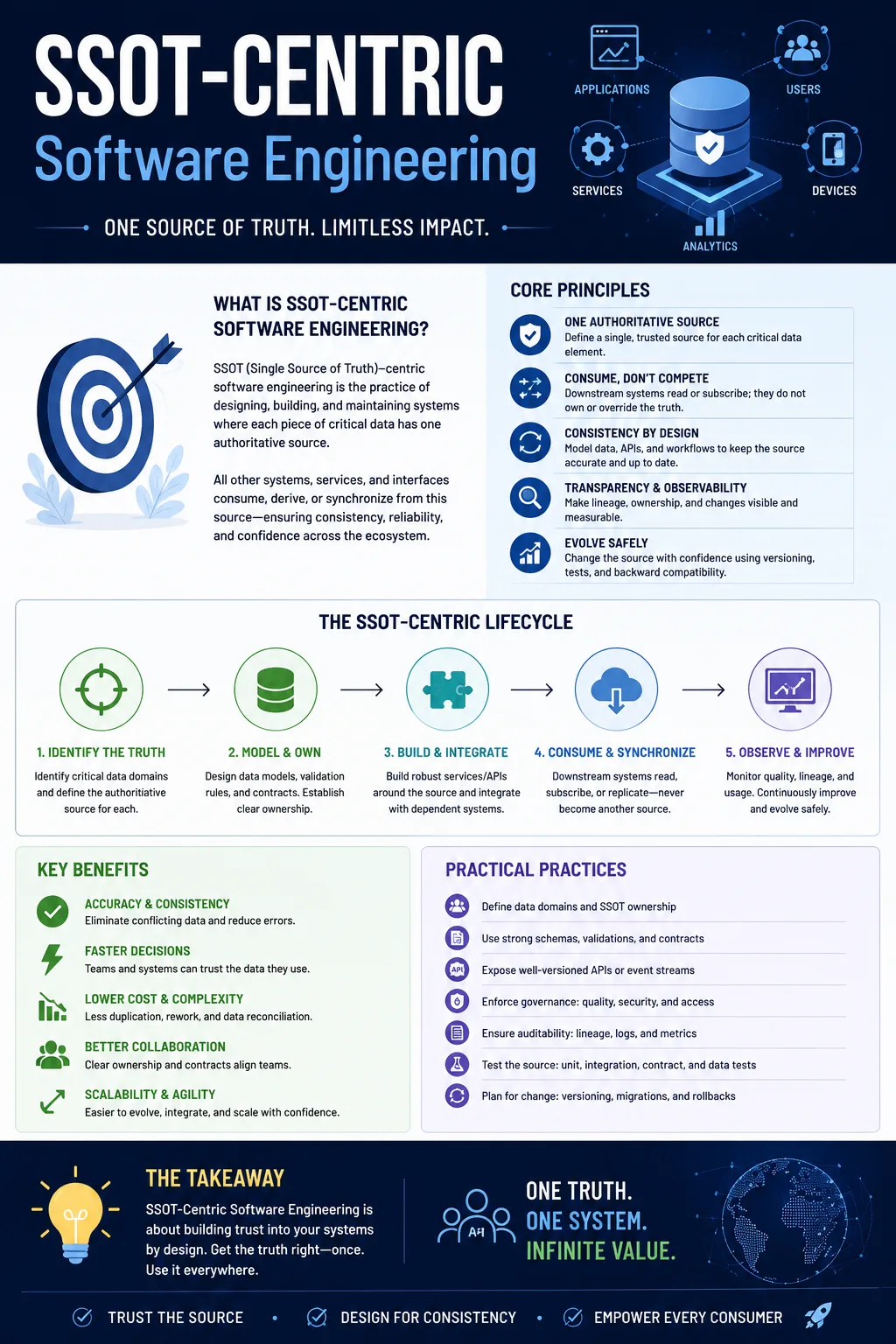
SSOT-Centric Software Engineering
The SSOT-ASEF positions a Single Source of Truth as the authoritative knowledge system guiding development, evolution, and governance of AI-native software systems.
Explore the knowledge base: github.com/eecheonwu/scse-knowledge-base